Heritage in motion
What ASI certification means when you buy an Italian classic — the CRS, the Targa Oro, and why an ASI-certified car is worth more. Explained by a dealer in Piedmont.
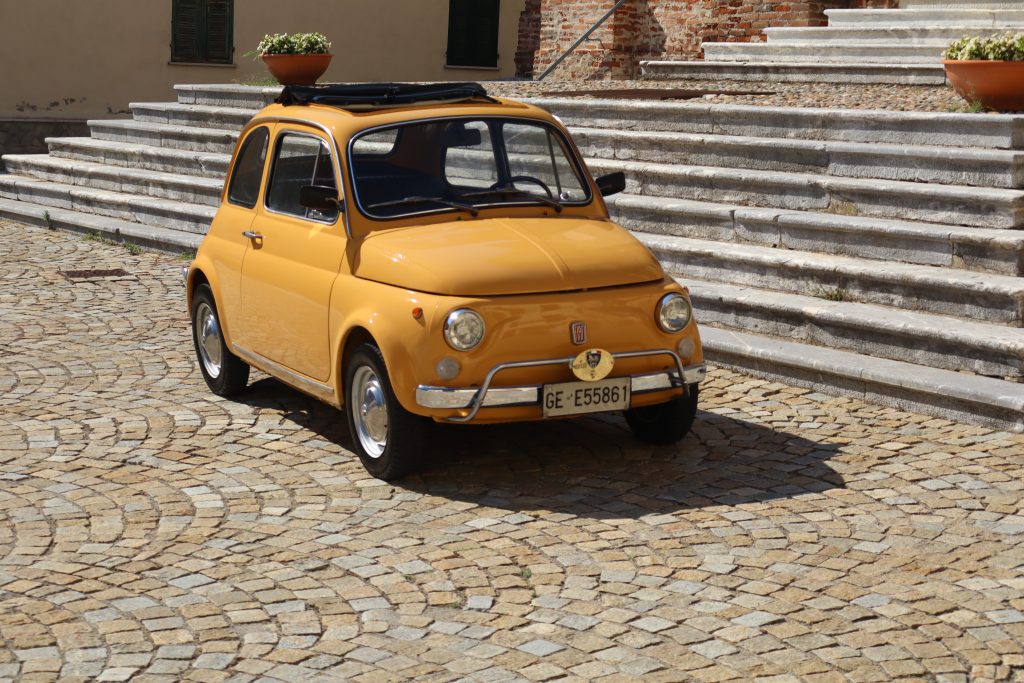
Italy did something with its motoring heritage that most countries never got around to. It decided the cars were worth keeping records of — properly, individually, one chassis number at a time.
The result is a system of certification that has been running since 1966, and a set of documents you’ll see referenced in almost every Italian classic car advert. Certificata ASI. CRS. Targa Oro. For anyone buying from outside Italy, these are usually the most valuable pieces of information in the listing, and almost nobody explains what they are.
So here’s the whole picture: what ASI is, what each certificate says about a car, and why a Targa Oro on the bulkhead can be worth thousands of euros on its own.
What ASI is
The Automotoclub Storico Italiano is Italy’s national federation for historic vehicles. It was founded in 1966, it operates from Villa Rey in Turin, and it brings together more than 350 affiliated clubs and over 350,000 members.
Two things separate it from an ordinary enthusiasts’ organisation.
It is recognised by the Italian state. Article 60 of the Italian Highway Code — the article that defines historic and collectors’ vehicles — names ASI as a certifying body. When ASI certifies a car, that has consequences in Italian law: for how the car is taxed, and for whether a long-dormant car can be brought back onto the road at all.
It is the Italian authority for FIVA, the Fédération Internationale des Véhicules Anciens, which represents historic vehicle owners in more than 70 countries and works with UNESCO on heritage recognition. That’s what connects an Italian certificate to the wider world.
Behind the certificates sits a genuine expert structure: around 1,000 technical referents at club level and roughly 200 national technical commissioners, specialised by category and by marque. Their competence is accredited by Accredia, the Italian national accreditation body, under a formal professional profile for historic vehicle experts.
That last detail is the one that matters to a buyer. When an Italian classic is examined, it is examined by someone who has looked at hundreds of that exact model — not a generalist with a clipboard.
Alongside ASI, Italian law recognises four marque and category registers on equal footing: the Registro Italiano FIAT, the Registro Italiano Alfa Romeo, the Registro Storico Lancia and the Registro Storico FMI for motorcycles. A certificate from one of these carries the same legal weight as an ASI one, and for a marque specialist car it’s often the more knowledgeable route.
The CRS: the certificate every good Italian classic should have
The Certificato di Rilevanza Storica is a modest-looking thing. Two sides of A4, stapled. Nothing about it announces itself.
What it contains is the car, written down.
- Make, type and body style
- Year of construction and year of first registration — separately, which matters more often than people expect
- Chassis number, and where on the car it’s stamped
- The original manufacturer’s identification plate
- Engine and transmission details
- Weights, dimensions, seating
- Previous Italian plates, and previous foreign plates if the car was imported
- A dedicated section recording any departure from the original factory specification
That last section is the heart of the document. The CRS doesn’t hand out a grade — it sets down what was actually found. If a car has a period-correct replacement engine, the CRS will normally say so. If it’s untouched, the section stays clean, and that clean section is worth reading.
And this is the part that gets missed: it isn’t a printout. The data doesn’t come from a database. A club technical referent examines the physical car, checks the numbers against the documents and the documents against the metal, and records the result. The paper is plain. The work behind it isn’t.
What a CRS gives the car:
- Formal status as a veicolo di interesse storico e collezionistico under Italian law
- The road tax treatment for cars aged 20 to 29 (more on that below)
- The ability to re-register a car that was struck off the national register — which is how a car that sat in a barn for thirty years with no plates gets back on the road legally
Introduced in 2010 under a ministerial decree of 17 December 2009, the CRS replaced the older Certificato delle Caratteristiche Tecniche. It’s available for cars and motorcycles over 20 years old, judged on age, originality and state of preservation, and it’s normally issued within about two months.
For a buyer, the CRS is the baseline. It means a qualified person stood in front of this specific car and wrote down what they saw.
The Targa Oro: the highest recognition ASI gives
Then there’s the other one.
Officially it’s the Certificato di Identità. Nobody calls it that. Everybody calls it the Targa Oro — the gold plate — because it comes with a physical metal plaque granted for use on the car alongside the certificate.
This is the top of the Italian system. It is not an upgraded CRS or a longer version of the same inspection. It’s a different process entirely.
The examination is national, not local. A CRS is assessed by a club technical referent. A Targa Oro is assessed by national technical commissioners — the specialists — at dedicated homologation sessions held to a published calendar. The commissioner examining a Giulietta Sprint is someone who knows Giulietta Sprints.
The standard is the FIVA International Technical Code. The car is classified both by type and by preservation group under an international framework, not an Italian house standard.
The evidence required is far heavier. Photographs to a specified format. Material sampling. Documentation of the car’s history where it exists.
And the bar is originality. This is the point. A Targa Oro is not given for a car that looks good. It’s given for a car that is what it claims to be — correct in specification, correct in construction, correct in the details that a specialist knows to look at and a general inspector doesn’t.
The certificate that comes back records photographs, dating, identifying details, a description of the state of preservation or of the restoration carried out, the classification, any deviation from original specification found, and — where the history is known — a summary of the car’s life.
You do not get one easily. That’s precisely why it counts.
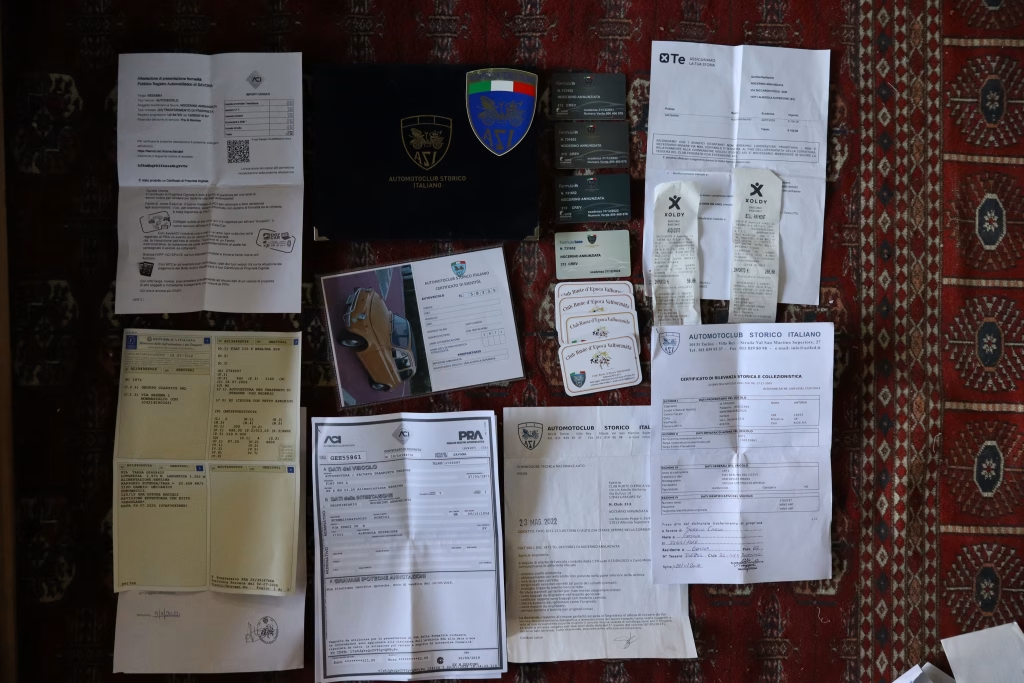
What certification is worth in the market
Here is the practical reality of the Italian market: a Targa Oro car sits in a different bracket.
Two cars, same model, same year, similar mileage. One carries the gold plate and the other doesn’t. The certified car doesn’t sell for a slightly better price — it sells in a different conversation, often for thousands of euros more, and it sells faster.
The reason isn’t mystique. It’s three things.
Scarcity. Because the standard is originality and top condition, the population of Targa Oro cars is genuinely small. Most survivors don’t qualify. Many owners never even present the car, knowing it wouldn’t pass.
Independent confirmation. In a market where every seller describes their car as original, a Targa Oro is the closest thing available to a specialist saying so on the record — someone with no interest in the sale, examining the actual car.
Collector standing. The plate becomes part of the car’s story. It travels with it, gets referenced in every subsequent listing, and joins the folder that a serious collector expects to see. Cars accumulate documentation the way they accumulate history, and a Targa Oro is the strongest single item that folder can contain.
The effect is strongest exactly where you’d expect: on cars where originality is the proposition. An unrestored 500 in first paint. An early Giulietta. A car whose whole appeal is that nobody got to it. For a heavily modified or rebuilt-to-taste car the Targa Oro isn’t the relevant document — such a car wouldn’t be presented for one — and that’s fine. Different cars, different value.
A CRS moves the needle too, more quietly. It doesn’t carry the prestige, but it confirms the car’s identity, unlocks the fiscal treatment, and tells a buyer the fundamentals were checked by someone qualified. On an ordinary good car, having it beats not having it every time.
The peace of mind, especially from a distance
This is what certification really does for anyone buying an Italian classic from another country.
Buying remotely is an act of trust. You’re reading a description written by the person who wants your money, looking at photographs chosen by the same person, and deciding whether to send a wire transfer to a country you may never have bought a car in.
An ASI certificate changes the shape of that. It means an expert, unconnected to the sale, physically examined the car and set down what they found — the chassis number, where it’s stamped, whether the identification plate is the original one, whether the specification matches the factory. With a Targa Oro, it means a national specialist in that model did it, to an international standard.
That doesn’t make the inspection unnecessary. It makes it a confirmation rather than a leap.
Three things worth doing with the documents:
Ask for every page. The cover tells you a certificate exists. The inside pages tell you what was found. Any honest seller will send the lot.
Read the deviations section. It’s a feature, not a warning. A certificate that notes a replacement fuel pump is a certificate that was taken seriously.
Verify it. ASI operates an online lookup for dematerialised CRS documents, so a certificate can be checked rather than taken on faith.
The FIVA card: the international layer
Where ASI certification is Italian, the FIVA Identity Card is the passport version.
FIVA defines a historic vehicle as mechanically propelled, at least 30 years old, preserved in historically correct condition, and not used as daily transport. A card is issued after physical inspection against the FIVA Technical Code, and ASI issues them in Italy as the national authority.
What it gives the car:
- A unique FIVA Registration Number, and entry in the international FIVA database
- Recognition at national and international events — and eligibility for events run under FIVA rules
- A standardised record of specification, modifications and photographs, tied to the vehicle
- A document explicitly described as helpful in obtaining historic vehicle recognition in other countries
There’s a 20-to-29-year equivalent, the FIVA Youngtimer Registration Document, for cars that will become eligible for the full card at 30.
One practical thing worth knowing before you buy a car advertised with one: the FIVA card belongs to FIVA and becomes invalid when the car is sold, and in any case runs for ten years. You’d apply for a fresh one in your own country. The existing card is still excellent evidence of how the car was recorded at a given date — it just isn’t a live document you’re inheriting.
What it means for running the car in Italy
If the car is staying in Italy, certification has direct financial effects.
Road tax at 30 years and over. Exemption from the annual ownership tax is automatic under Article 63, paragraph 1 of Law 342 of 21 November 2000 — no application, no membership required. If the car is used on public roads, a flat annual circulation charge applies instead, set regionally and generally in the region of €25 to €31 for cars, with lower figures for motorcycles. Carry the receipt. Vehicles in professional use are excluded from the exemption.
For scale: ordinary Italian road tax runs at €2.58 per kW up to 100 kW and €3.87 per kW above. On a 162 kW car that’s roughly €487 a year at full rate, against the flat charge or nothing when exempt.
Road tax at 20 to 29 years. This is where a CRS pays for itself. National law provides a 50% reduction for vehicles in this band, on two conditions: the car holds a CRS from one of the recognised registers, and the historic status is annotated on the registration document. That annotation is a separate administrative step and it’s routinely forgotten — the certificate alone won’t do it.
Road tax is administered regionally in Italy and the regions have implemented the 20–29 band differently, so confirm the current position for the region where the car is registered.
Insurance. Italian insurers offer dedicated historic vehicle policies to owners of certified cars — limited annual mileage, and materially lower premiums than standard cover. Membership of an ASI-affiliated club is the usual way in.
Roadworthiness testing. Certified historic cars follow the ordinary Italian schedule: first test four years after registration, then every two years. Since November 2021, cars registered before 1 January 1960 can be tested at any authorised workshop rather than only at the Motorizzazione, and a December 2024 decree simplified pre-1960 testing further. Where a rolling road isn’t usable, braking can be measured by GPS deceleration testing from 40 km/h. The test currently costs around €88.
If you’re exporting the car, the Italian tax position stops applying at the border — but the documents themselves travel with the car and keep their value as provenance.
How to read an Italian classic car advert
| Italian | What it means |
|---|---|
| ASI Oro / Targa Oro | Holds the Certificato di Identità — ASI’s highest recognition |
| CRS | Certificato di Rilevanza Storica |
| Iscritta ASI | Registered with ASI — worth asking which certificate |
| Nuova revisione | Fresh roadworthiness test, valid two years |
| Targhe originali | Original registration plates retained |
| Targhe nere | Black plates — Italian plates issued before 1985 |
| Libretto / Carta di circolazione | Vehicle registration document |
| Documento Unico | The combined registration and ownership document, since 2020 |
| Foglio complementare | The older ownership document |
| Conservata | Preserved, unrestored |
| Restaurata | Restored |
| Prima vernice | Original paint |
| Un solo proprietario | One owner from new |
| Numeri concordanti | Matching numbers |
| Radiata dal PRA | Struck off the register — needs re-registration, and needs a CRS to do it |
Four questions worth asking any Italian seller:
- Which certificate does it hold — CRS, Targa Oro, or both? May I see all the pages?
- Is the historic status annotated on the registration document?
- What does the deviations section record?
- When was the last revisione?
How a car gets certified
Certification runs through clubs rather than directly through ASI.
The owner joins ASI and a local affiliated club — there’s at least one in most provinces. The application goes in through the club, whose technical referent is the direct contact and whose secretariat is the channel to ASI’s general secretariat. For a CRS, the file needs the application form, registration document, proof of ownership, ID, and photographs — typically six or seven digital images for a car, more for a non-circulating one. Speak to the club before shooting them; the format requirements are specific.
The referent then examines the car for a CRS. For a Targa Oro or a FIVA card, the car goes to a homologation session and is examined by national commissioners.
Rough costs, which vary by club and should be confirmed rather than assumed:
| Item | Approximate |
|---|---|
| ASI membership (ASI portion) | ~€41/year |
| ASI plus affiliated club | ~€100–140/year |
| CRS application | ~€20–100 depending on club |
| CRS for re-admission to circulation | ~€150 |
| Certificato di Identità (Targa Oro) | Higher — ask the club |
| Transfer of a certificate to a new owner | ~€30, often ~€80 from a commercial seller |
| Historic vehicle insurance | ~€100–150/year |
| Roadworthiness test | ~€88 |
Certificates don’t expire, but they’re tied to the registered owner — which is why the transfer step exists.
Frequently asked questions
What is the difference between a CRS and a Targa Oro? The CRS records and confirms the car’s identity and gives it legal historic status in Italy — tax treatment and re-registration. The Targa Oro, formally the Certificato di Identità, is ASI’s highest recognition: examined by national specialists against the FIVA International Technical Code, awarded on originality and condition. The CRS is the foundation; the Targa Oro is the distinction.
Does a Targa Oro really make a car worth more? In Italy, yes — often substantially. It’s scarce, it’s independent, and it’s the strongest confirmation available that a car is original. The effect is largest on cars where originality is the main attraction.
Is ASI certification mandatory? No. It isn’t required to own or drive a classic in Italy. It’s required for the 20-to-29-year tax reduction, and effectively required to re-register a car that has been struck off the register.
Does a 30-year-old car need ASI certification to be tax exempt? No — that exemption is automatic under Law 342/2000. ASI certification is about identity, originality and standing, not about the over-30 exemption.
Is a marque register certificate worse than an ASI one? No. The Registro Italiano FIAT, Registro Italiano Alfa Romeo, Registro Storico Lancia and Registro Storico FMI are named in Article 60 alongside ASI and carry the same legal weight. For a marque specialist car they can be the better route.
Does a FIVA card transfer with the car? No. It belongs to FIVA and becomes invalid on sale, and it expires after ten years. You would apply for a new one in your own country.
How long does certification take? A CRS is generally issued within about two months. A Targa Oro depends on the homologation session calendar, so allow longer.
What if a car has no certification at all? Common, and not in itself a concern — many owners simply never applied. The useful question is whether the car was ever presented and turned down, which is a different thing entirely.
In short
The Italian system rewards cars that were looked after. A CRS says the car’s identity has been checked and written down by someone qualified. A Targa Oro says a national specialist examined it against an international standard and found it to be, in condition and in originality, among the best of its kind.
That’s why a certified car costs more, and why it’s worth more when you come to sell it. Not because of the paper. Because of what the paper took to earn.
We’re in Ceva, in the hills between the Langhe and the Ligurian coast, and every car we offer comes with its documents explained rather than listed. If you’re weighing up a car — ours or anyone else’s — and you’d like a second opinion on what its papers actually say, ask us.
Sources
- Automotoclub Storico Italiano — historic vehicle certification: asifed.it/certificazione-auto-storiche
- FIVA — Fédération Internationale des Véhicules Anciens: fiva.org
- Italian Highway Code, Article 60
- Law 342 of 21 November 2000, Article 63
Last reviewed August 2026. Italian tax and registration rules change and road tax is administered regionally. General information, not legal or tax advice — confirm the current position for your region before relying on it.