a short automotive essay on the Fiat Barchetta
Fiat 500: The Tiny Car That Carried Italy Through War, Politics and Pop Culture
description: Discover the story of the Fiat 500: from post-war Italian survival machine to fashion icon and modern classic. A journey through generations, politics, steel, culture and design.
The Fiat 500 Was Never Just a Car
Some cars are built to impress. Others are built to survive. The Fiat 500 belongs to the second category.
It was never designed to make its owner feel like a millionaire. It had no roaring engine, no leather-lined cockpit, no ability to announce your arrival from three streets away. In fact, early versions were so small that parking one felt less like driving and more like placing a handbag on a table.
And yet, somehow, this tiny Italian machine became one of the most important cars in automotive history.
That is because the Fiat 500 was not created in a time of luxury. It was born from necessity, from a country rebuilding itself after war. Factories searching for a purpose and from a society dreaming of a better future.
The Fiat 500 was Italy’s little miracle.
Before the 500: A Country Looking for Wheels
To understand the Fiat 500, you have to understand Italy after the Second World War.
The country was exhausted. Cities had been damaged, industry had collapsed, and ordinary people were not thinking about grand touring machines. They needed affordable transport. Europe was entering a new era. Germany had the Volkswagen Beetle. France had the Citroën 2CV. Britain had the Morris Minor. Italy needed something similar: a car for everyone.
The answer came from Fiat, one of the country’s industrial giants.
Fiat had factories, engineers and ambition, but it also had a challenge: how do you build millions of cars for people who have very little money? The solution was simple: Make it small, light and as affordable as possible. Every car came with a sunroof, not as a option, not as luxury, all because after the war steel was more expensive then vinyl. The body lines are simple and shaped to use as little steel as possible.
Before the Fiat 500: 1936–1955 The Topolino Era
Before the famous 500 arrived, Fiat had created a other tiny revolutionary car: the Fiat 500 Topolino. the name means “little mouse”, which was surprisingly accurate. It was small, charming and slightly adorable. Introduced in 1936, it was one of the world’s first truly affordable small cars.
But history had other plans.
The Second World War interrupted everything. Factories were redirected toward military production, materials became scarce, and civilian dreams were put on hold. Steel was no longer going into family cars. It was going into weapons. When peace finally returned, Italy had to rebuild both physically and emotionally. The Topolino had shown the idea was possible, but the future needed something even cheaper. Something designed for a new Italy rebuilding it selff.
1957: The Birth of the Icon
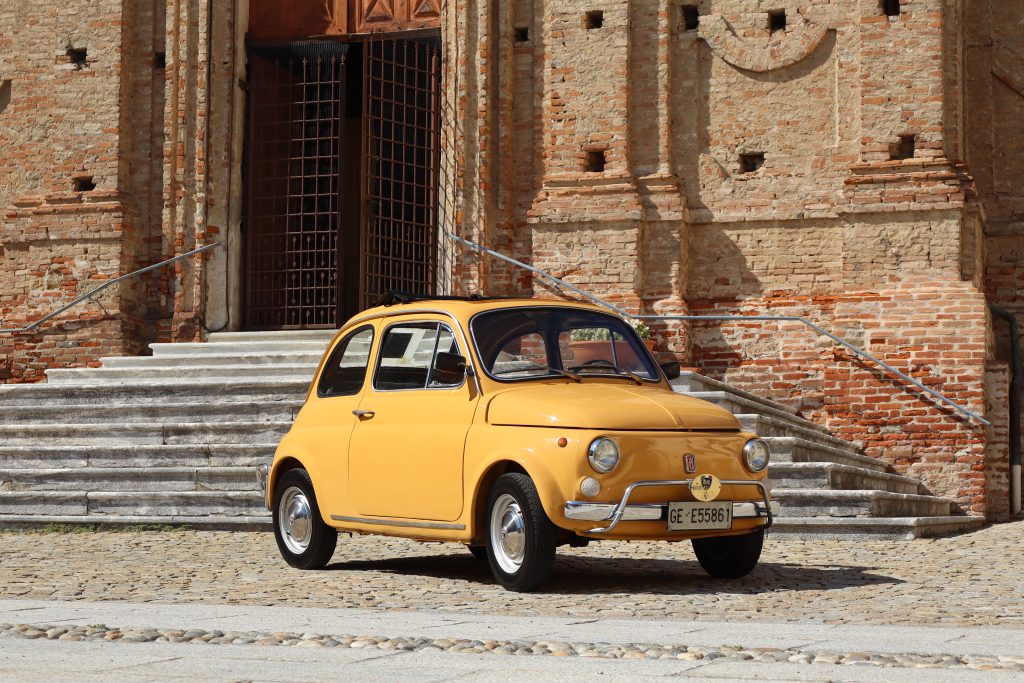
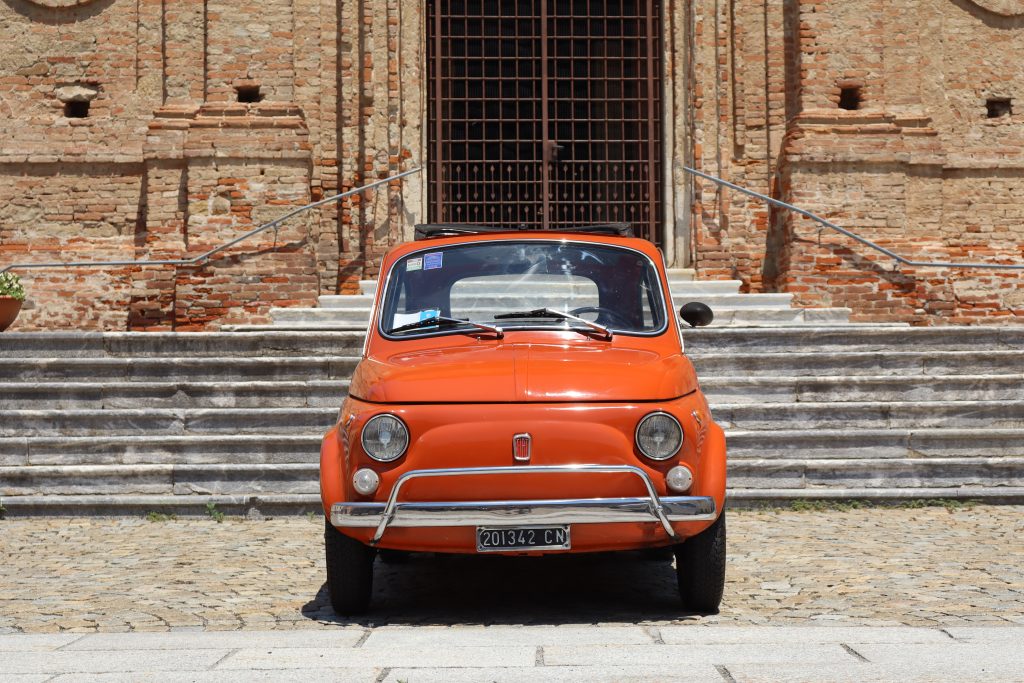
Then came 1957. The year the world met the original Fiat 500. Designed by Dante Giacosa, the new Fiat 500 was a masterpiece of intelligent simplicity. It used a tiny two-cylinder engine mounted at the rear. It had just enough space for a family, a few bags, and possibly a small dog who questioned the quality of Italian engineering.
It was not fast.
It was not luxurious.
It was not powerful.
But it was freedom.
For millions of Italians, owning a Fiat 500 meant something bigger than transportation.
It meant: Weekend trips to the coast, independence, modern life joining the economic boom.
The Economic Miracle: When Italy Found Its Confidence
The late 1950s and 1960s became Italy’s “economic miracle”.
Factories expanded. Cities grew. Television arrived. Fashion, cinema and design exploded. The Fiat 500 became the soundtrack of this transformation. It appeared everywhere: Outside cafés, in crowded city streets. Carrying families into a new era.
It represented optimism. A country that had been destroyed by war was suddenly stylish again. The little Fiat was not just a machine. It was part of the national identity.
The 1960s and 1970s: From Transport to Culture
By the 1960s, the Fiat 500 had become more than practical transport.
It became a cultural object. Italian cinema loved it because it represented ordinary life. It was humble, funny and unmistakably Italian. While Hollywood celebrated huge American cars with enormous engines, Italy celebrated a car that could barely overtake a bicycle. And somehow, that made it cooler. The Fiat 500 fitted perfectly with Italy’s philosophy: Why shout when you can charm?
The Generations of the Nuova 500: A Mirror of a Changing Italy
The beauty of the Fiat 500 is that it did not remain frozen in time. Like Italy itself, it evolved.
The original Nuova 500(N), introduced in 1957, was born from necessity. But as the country changed, so did the little Fiat. Each generation became a reflection of Italian society. From post-war recovery to economic confidence, from simple transportation to a symbol of style.
The 500 D (1960–1965)
It arrived during the beginning of Italy’s economic miracle.
Factories were expanding, millions of people were moving from rural areas into cities, and a new middle class was emerging. For many Italians, the 500 D was the first taste of personal freedom. It was not just a way to get from A to B. It meant you could drive to work, take your family on holiday, visit the coast on a Sunday afternoon and experience a world that had previously been out of reach. The funny thing is that the growing economics of the rebuilding Italy was shown in its sun roof. It shrinked the 500 N was rather a cabrio whereas the 500 D had gotten more of a sunroof. Showing the metal production after the world war had gotten better again.
The little Fiat was becoming a symbol of progress.
Then came the 500 F (1965–1972),
perhaps the most important version of the classic 500.
This was the Italy of optimism. The country was no longer simply rebuilding itself; it was becoming fashionable. Italian design, cinema and industry were gaining international attention. The same nation that produced beautiful furniture, architecture and exotic sports cars was also creating a tiny everyday hero.
The 500 F introduced practical improvements, including front-hinged doors, making the car easier and safer for modern use.
But its biggest achievement was cultural.
It became the car of ordinary Italians. A factory worker, a young couple, a small family — everyone could have one. While other countries were fascinated by size and horsepower, Italy showed the world that cleverness and personality could be just as important.
In 1968, Fiat introduced the 500 L (Lusso).
The name itself tells the story. Italy had moved beyond survival. People wanted more than basic transportation. They wanted comfort, character and style.
The 500 L received a more refined interior, improved details and a touch of elegance. It was still tiny, still simple, but now it had become something more emotional.
The Fiat 500 was no longer just a machine. It was part of the Italian lifestyle. It fitted perfectly into a country where design mattered as much as function.
The final chapter of the original generation was the 500 R (1972–1975).
By now, the Italy that had created the 500 was entering a new and more complicated era.
The economic miracle was slowing down. Europe faced oil crises, political uncertainty and changing consumer expectations. People began looking for larger, safer and more powerful cars. The tiny Fiat, once seen as the future, was becoming a charming reminder of another age. The 500 R borrowed technology from the newer Fiat 126 and represented the final evolution of the original concept. When production ended in 1975, more than four million examples had been built.
A car that started as a solution to post-war poverty had become one of the most beloved symbols of Italian identity.
The Return: Fiat 500 (2007) — Retro Becomes Cool Again
In 2007, Fiat revived the name with a modern interpretation. the new Fiat 500 arrived during a period when car companies discovered something important: People do not only buy cars, They buy memories. The new model borrowed heavily from the original design: Round headlights, compact proportions, cheerful personality.
But underneath was modern technology, safety equipment and engines suitable for the 21st century. Unlike the original, this Fiat 500 was not about necessity. It was about lifestyle. It became a fashion accessory, loved mostly by woman. They were little and not fast, so they were found cute by all woman. Suddenly, driving a Fiat 500 was not a sign that you could not afford something bigger.
It was a sign that you understood style.
Fiat 500e: The Electric Future
The latest chapter is the electric era.
The Fiat 500e represents another turning point. The modern electric versions of cars started to exists because resources are becoming a global concern. Altough being a petrol head and having no effections with electric cars, the irony is beautiful: The Fiat 500 started as a symbol of doing more with less. Decades later, that philosophy became fashionable again.
Why Does the Fiat 500 Still Matter?
Because it tells a human story.
Many cars are remembered because they were fast. Some because they were expensive. The Fiat 500 is remembered because it was there. It carried families after war. It helped workers reach factories. It filled Italian streets during economic recovery. It became part of cinema, fashion and everyday life. It proved that a small object can have a huge impact.
My
My personal experience
Before i bough the first fiat 500, i tought very different about them. Although they looked iconic, being 2 meter long and the car having only 18hp scared me away to get to know more about them. When i finished the garage for Gruppo Classics in italy i was looking to buy the first car. I came to visit a Alfa romeo 1300 junior gt in swiss, just above the border of Como italy. Unfortunaltly the quality was far beyond as descriped and shown by pictures. I looked further for alfa’s. But then i found on subito a advert in Genua for a Fiat 500. The price was in a decent range to go and visit it. After investigating the car for quite some time i decided to take the gamble and buy it. This car changed my whole idea of the 500. The was no longer tiny, it fitted me easily. It was a blast driving it. It was not fast but it gave me the experience of what driving is about. A adventure to get it up to 110Km per hour. Every moment of driving it gave a smile on my face. Looking back, the Fiat 500 did something I never expected: it turned from the car I underestimated into the car that made me understand why we love classic cars in the first place. It is not about horsepower, speed or numbers. It is about character, connection and the stories created behind the wheel. My journey with the Fiat 500 started as a surprise and became a passion. Perhaps your own Italian adventure starts with one of these little legends.
Leave a Reply