
How to buy a classic car in Italy — where they rust, which documents matter, what a transfer costs, and how to buy from abroad. Written from a showroom in Piedmont.
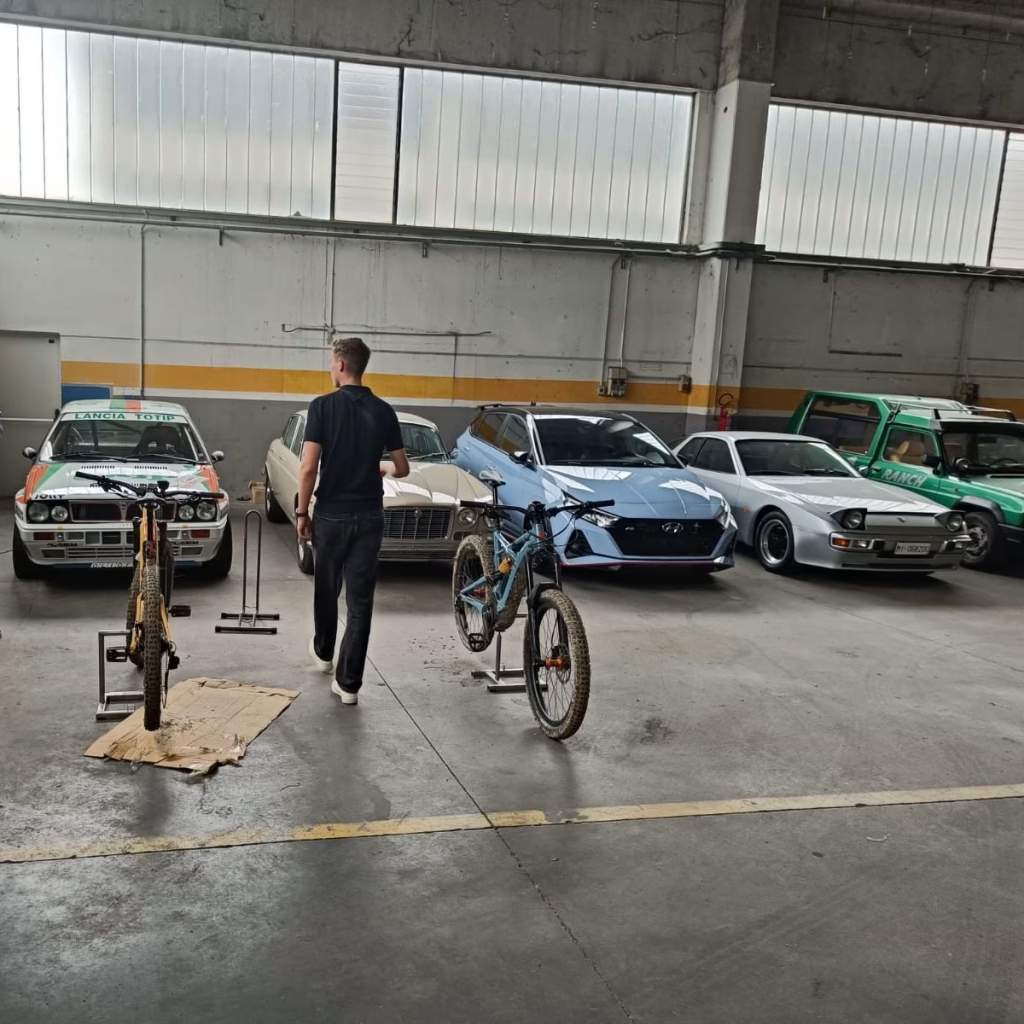
There are plenty of guides to buying a classic car. Check the rust, get an inspection, don’t fall in love. All true, all written by someone who has never bought a car in Italy.
Italy is different. The documents are different, the vocabulary is different, the way a deal is done is different, and the cars themselves rot in places that a British or German buyer wouldn’t think to look. None of that is difficult once you know it. All of it costs you money if you don’t.
This is what I’ve learned buying and selling here. I’m in Ceva, in the hills of Piedmont, and I’ve been in this trade since I was fourteen. Some of what follows is technical, some of it is cultural, and the cultural part is the half nobody writes down.
North or south? The question that actually matters
The reason people come here is climate. Italian cars have generally lived without road salt, and a car that spent fifty years here is usually structurally better than the same car from the Netherlands, Britain or northern Germany. That’s not marketing — it’s why the trade flows the direction it does.
But “Italian car” tells you almost nothing on its own. Italy runs fifteen hundred kilometres from the Alps to Sicily and the difference between a car from Cuneo and a car from Catania is larger than the difference between a Dutch car and a Belgian one.
So the question is never “is it Italian?” It’s where in Italy did it live, who has worked on it, and what has the weather done to it.
What the south does to a car
Southern Italy and the islands — Sicily, Calabria, Puglia, Sardinia — get materially more sun than the north, and get it for more of the year. That’s excellent for steel and brutal for everything else.
Paint. Ultraviolet light breaks down pigment and binder. On an older single-stage finish it shows as fading and chalking: a red that has gone pink and dusty, a blue that’s turned matt on the horizontal panels and is still glossy down the sides. On later clearcoated cars it shows as the lacquer lifting and peeling. Roof, bonnet and boot lid always go first, because they take the sun square on.
Rubber and trim. Window seals, door rubbers and wiper blades harden, shrink and crack. That matters beyond appearance: a shrunken windscreen seal lets water into the screen surround, and that’s where the rust you didn’t expect on a southern car comes from.
Interiors. Cracked dashboards, brittle plastics, sun-bleached upholstery, a faded parcel shelf. On a car where the interior is the expensive part to put right, this is real money.
What you get in exchange is metal. Less humidity, no road salt, and a dry climate for decades. Southern cars are frequently sound in the places that actually matter — floors, sills, chassis rails — while looking tired on the surface.
What the north preserves, and what it doesn’t
Up here the sun is weaker and the summer shorter. Original paint survives far better; I’ve seen fifty-year-old cars in Piedmont still wearing a factory finish you can polish back. Rubbers and interiors last longer for the same reason.
The north’s problem is water rather than light. Winter fog sits in the Po valley for weeks, and a car stored in a damp barn near Milan or Bologna rusts from the inside out without ever seeing a gritter. Turin and Milan do salt their roads in winter. And Liguria and the Adriatic coast carry salt air year round.
So a northern car is not automatically the sound one. A Ligurian coastal car can be worse underneath than a Sicilian one. But in general a northen italian car from the country side is the better preserved one.
The thing the Italian trade doesn’t say out loud
Here’s the part nobody writes down, so I will: the standard of bodywork and paint is not uniform across Italy, and it isn’t close.
The north is where the industry was. Turin built the cars; Milan, Emilia and the Veneto built everything that went into them. Half a century of that leaves a dense network of body shops, paint shops, trimmers and machinists who worked to factory standards because the factories were their customers. Proper spray booths — sealed, filtered, extracted, with controlled temperature and a heated curing cycle — are ordinary equipment here, because the volume of work justified buying them.
In parts of the south and on the islands that infrastructure is thinner. The work is often done in an open workshop or a partially enclosed bay rather than a certified booth: no extraction, no filtration, no dust control, no temperature control. That’s not a comment about the people doing it — plenty of them are excellent craftsmen working with what the local market will pay for. It’s a comment about equipment, and equipment is what a paint job depends on.
What that produces on the car:
- Dust and debris in the finish. Look across a panel with the light low and along the surface, not straight on. Nibs, specks and inclusions sitting under the top coat are the signature. They can’t be polished out because they aren’t on the surface.
- Orange peel. A rippled, dimpled texture instead of a flat reflection, caused by paint that didn’t flow before it flashed off. Often a temperature problem.
- Solvent pop. Tiny pinholes or blisters where solvent was trapped by a coat applied too soon or forced to dry too fast.
- Poor adhesion later. Paint sprayed onto inadequately prepared or contaminated surfaces looks fine for two years and then lifts at the edges — around window apertures, along door bottoms, at panel joins.
- Overspray everywhere. In the door shuts, on rubbers, on the underside of the bonnet, on suspension components. A booth job with proper masking doesn’t do this.
How to check, in ninety seconds:
Get the car outside, in daylight, and crouch so you’re looking along a panel rather than at it. Reflections tell you everything a straight-on photograph hides. Open every door, the bonnet and the boot and look at the shut faces — a car resprayed properly has colour continuity in the shuts; a quick job usually doesn’t, and you’ll often find the original shade still there. Run a finger along the rubbers for overspray. And if you’re serious about the car, use a paint depth gauge — a spessimetro — which costs very little and will tell you in one pass across the car whether the panels carry factory thickness or three times it.
None of this means walk away. A southern car with tired paint and sound metal can be an excellent purchase — you’re buying the part that’s expensive to replace and repainting the part that isn’t. It means price it for what it needs, and know that a “recent respray” on a car from certain places is a question rather than a selling point.
And yet the south is where the cars are
Now the other side, because the economics run exactly opposite to the workmanship.
The north was rich earlier and stayed richer. Cars there were replaced on a normal cycle — sold on, traded in, eventually scrapped. The south had lower incomes for most of the post-war period, so cars were kept, repaired, handed down and used for far longer than they were anywhere else in western Europe. A Fiat that would have been scrapped in Turin in 1985 was still someone’s transport in Calabria in 2005.
The result is straightforward: there are simply more survivors in the south, they often have fewer owners and lower mileage, and they cost less. Fewer local collectors are bidding for them, and the sellers are frequently families rather than dealers.
That’s why the trade moves cars northward. Sound, cheap, sun-faded cars come up; they get sorted properly in a northern workshop; and they sell for more. There’s nothing underhand about it — it’s the value that gets added in between, and knowing where that value is added is most of this business.
As a buyer, the shape of it is this:
| conditions | Northern car | Southern / island car |
|---|---|---|
| Original paint and trim | Usually better preserved | Often UV-tired |
| Structural rust risk | Damp storage, city salt, coastal air | Generally lower |
| Quality of past repairs | More likely done to a high standard | More variable — inspect the paint |
| Supply | Fewer cars, more competition | More survivors |
| Price | Higher | Frequently better |
Neither is the right answer. A northern car costs more and asks fewer questions; a southern car costs less and asks you to look harder. What you should never do is buy either one on the strength of the word “Italian”.
I remember looking at an Alfa Romeo GT Junior from the Como area, close to the Swiss border. On paper, it was an interesting car, and at first glance the bodywork appeared quite convincing. The car had originally come from Sardinia, which made me pay a little more attention to the details of its history and restoration.
One of the things I did was lift the spare wheel out of the boot. The spare-wheel well looked perfectly respectable at first, but something about it immediately felt wrong. It was one of those details that is difficult to explain until you have seen enough cars. A little later, the penny dropped: the well was actually from an Alfetta, not a GT Junior.
The paintwork provided further clues. There were quite a few small dust inclusions in the paint, suggesting that the car had not been painted in a proper, well-controlled spray booth.
Then came another tell-tale detail. When I gently lifted the rubber seals around the windows, I could see paint mist underneath them. That is a small thing, but it tells a very different story from a car that has been properly stripped and refinished with the glass and trim removed.
For me, this GT Junior was a good reminder that the difference between a convincing restoration and a truly high-quality one is often hidden in the details. And when looking at cars from different parts of Italy, those details can tell you far more than the asking price ever will.
Where these cars actually rust
Forget the general advice and think about water. Rust starts where water sits and can’t drain, and where two panels are joined and the seam holds moisture. Every classic has those places. Learn where they are on your specific car and you’ve done most of the work.
The method, in order:
Bring a small magnet and a torch. Get underneath — properly underneath, not a crouch at the wheel arch. If the seller won’t let you, that’s your answer.
Press, don’t just look. Sound metal doesn’t flex. Push firmly on sills, floor pans and inner arches with your thumb. Filler and rusted-through steel with a skim over it both give way. A magnet that won’t stick tells you the same thing.
Read the panel gaps. Inconsistent gaps, a door that drops on its hinges, a bonnet that sits proud on one side — these are structural signals, not cosmetic ones. On a monocoque, a car that has rotted in the sills will have sagged in the middle, and the doors show it first.
Look for overspray and ripples. Overspray in the door shuts, on rubber seals or inside the engine bay means paint was applied with things still attached. Ripples in a reflection mean filler underneath.
On a Fiat 500 specifically, start here: floor pans, particularly where they meet the sills; the inner and outer sills themselves; the front panel and the area under the front luggage compartment where water gets in past the bonnet seal; the battery area; the door bottoms; and the rear corners of the engine bay. The 500 is a simple car and everything is repairable — but a car needing floors and sills is a different purchase to one that doesn’t, and the price should reflect it.
One thing people forget: repaired rust isn’t automatically a problem. These cars are fifty and sixty years old. What matters is whether the repair was done properly, in steel, with the structure restored — or whether someone put a plate over it and painted the lot. Ask what was repaired, when, and by whom, and ask for photographs of the work in progress. A seller who has them is a seller who did it right.
I once inspected a Fiat 500 Nuova F in Turin that looked solid at first glance, but the lower lip of the sill — the very bottom edge where the sill meets the floor — had been built up with such thick layers of paint that it was literally holding the sill and floor pan together.
The documents, and what each one proves
Italian classic car paperwork is a chain. Each document proves something different, and the gaps between them are where problems hide.
Carta di circolazione / Documento Unico. The registration document. Since 2020, registration and ownership have been combined into a single Documento Unico. Older cars may still show the previous separate documents. This tells you the car is registered, to whom, and in what specification.
Certificato di Proprietà. Proof of ownership, digital since 2015. On older transactions you may see a foglio complementare instead — the predecessor document. Whichever exists, it must name the person selling you the car.
Certificato di Rilevanza Storica (CRS). The certificate that gives the car legal status as a vehicle of historic and collectors’ interest, and the one that matters for tax and for re-registering a car that’s been struck off the register.
Certificato di Identità — the Targa Oro. ASI’s highest recognition, awarded on originality and condition after examination by national specialists. This is the one that adds real money to a car in Italy.
I’ve written all of this up properly in a separate guide to ASI certification, because it’s the single most misunderstood thing about buying Italian. Read it before you view a car that’s advertised as certified.
Revisione. The roadworthiness test — first at four years, then every two. “Nuova revisione” in an advert means a fresh certificate. It’s a genuine plus, and it is not a condition report. A car can pass and still need a great deal.
The original plates. Targhe originali means the car still wears the plates it was issued. Targhe nere — black plates — were used in Italy until 1985, and on a pre-1985 car they’re both correct and desirable. The plate prefix also tells you the province the car was first registered in. Torino, Genova, Cuneo, Milano: that’s where the car started its life, and it’s a genuine clue about its history and about how it was stored.
Service history. Less common on Italian cars than on German ones, and its absence isn’t damning on a 1960s utility car. Receipts for restoration work are worth more than a stamped book anyway.
What to check, always: that the chassis number on the car matches the chassis number on every document. Find where it’s physically stamped and look at it, don’t take a photograph of a plate as proof. Mismatches, restamped areas and welded-in sections around the number are the end of the conversation.
[YOUR STORY — the paperwork one.] A car where the documents didn’t line up, or where digging into the paperwork turned up something good. Short and specific.
What it costs to buy, beyond the price
If you’re registering the car in Italy, the transfer of ownership — passaggio di proprietà — has two parts.
Fixed costs: €101.20. This covers ACI emolumenti, stamp duty for the PRA registration, Motorizzazione fees and the stamp for authenticating the signature. It’s the same for every car.
IPT — the variable part. The Imposta Provinciale di Trascrizione is a provincial tax that normally scales with engine power, starting around €150 for cars up to 53 kW and rising from there. Provinces can add a surcharge of up to 30%, so the same car costs different amounts in different provinces.
Here’s the part worth knowing. For vehicles over thirty years old that are registered as historic, the IPT drops to a fixed €51.65. So a transfer on a genuinely historic car costs around €153 in total, rather than €250 to €550.
Two caveats. Since 1 January 2015 the reduction has applied only to vehicles over thirty; twenty-to-twenty-nine year old cars no longer qualify nationally. And provinces set their own rules — some are more generous. Confirm with the province where the car will be registered before you budget.
If you’re exporting rather than registering here, none of this applies. That’s a different process with different costs, and I’ve written that one up too — see exporting a classic car from Italy.
Buying without standing next to the car
Most of the people I sell to never see the car before it arrives. That’s normal now, and it works — but only if you replace the physical inspection with something equally rigorous.
Ask for photographs you didn’t choose. Anyone can send twenty flattering pictures. Ask for specific ones: the floor pans from underneath, both sills, the inside of the wheel arches, the boot floor, the chassis number as stamped, the engine bay from four angles, and the worst part of the car. That last request tells you a lot about the seller regardless of the photograph you get back.
Ask for a video with sound. Cold start, idle, and a drive. You will hear things a photograph cannot show.
Ask for the full documents, every page. Not the cover of the certificate — the inside, including the section that records deviations from original specification.
Get an independent inspection. Marque clubs, ASI-affiliated clubs and independent inspectors all operate in Italy. On a car above a few thousand euros this is not optional, and the cost of it is trivial against what it prevents.
Talk to the seller on the phone. Not messages. Five minutes of conversation tells you whether someone knows the car they’re selling. Ask what they’d fix first if they were keeping it. Honest sellers always have an answer.
How a deal is actually done here
This is the part that isn’t in any other guide, and it’s where foreign buyers most often go wrong.
The advert price is a starting position, but not by much. Trattabile means negotiable. If it doesn’t say trattabile, there’s less room than you’d think — but there is always some. What there isn’t, on a good car with a proper history, is a large discount for arriving with cash and confidence. That approach reads as disrespect here, and it closes doors.
Relationship comes before price. An Italian seller with a car they’ve cared for is choosing who gets it, not just what they’re paid. Time spent talking about the car — its history, where it lived, what the owner did with it — is not small talk before the real conversation. It is the real conversation. Turn up, be interested, and the price question gets easier.
Be specific when you negotiate. “Can you do better?” achieves nothing. “The inspection found the brakes need overhauling, which is €X — would you consider adjusting for that?” is a conversation. Informed and polite beats aggressive every time, and here more than most places.
Deposits are normal, receipts are essential. A deposit to hold a car is standard practice. Get it in writing, with the car identified by chassis number, the amount, and what happens if either side withdraws.
Be prepared to walk away. Not as a tactic — as a genuine position. There is always another car. The buyers who overpay are the ones who arrived having already decided.
Don’t be afraid to walk away. Seriously. Showing you’re prepared to walk away if your terms aren’t met is often the strongest negotiating tactic. I once walked away 3 times during the visit of a Alfa Romeo spider till the owner agreed to lower the price.
Red flags
None of these is automatically fatal. All of them mean stop and ask a direct question.
- A chassis number that’s hard to see, freshly painted over, or in a section that’s been welded
- A seller who won’t let you get underneath, or who won’t send the photograph you asked for
- Fresh underseal on a car that’s supposedly never needed work
- A certificate shown as a cover photograph only
- A car described as conservata — preserved — that’s wearing new paint
- Documents in a name that isn’t the seller’s, with no clear explanation
- Radiata dal PRA not mentioned until late in the conversation
- A price well below the market for that model in that condition
That last one deserves its own sentence. The Italian classic market is well-mapped and sellers know what their cars are worth. A car priced far below its peers is priced that way for a reason, and the reason is rarely your good fortune.
And then you own it
If the car stays in Italy, you do the passaggio di proprietà and you’re finished.
If it’s leaving, there’s a sequence — valid revisione, deregistration from the PRA, and either a ship or a set of temporary export plates. It’s straightforward, it costs around €200 at the ACI counter, and it takes about a week. The export guide covers all of it, including shipping from Genoa and importing into the United States.
Frequently asked questions
Is it safe to buy a classic car in Italy from abroad? Yes, with the same care you’d apply anywhere: an independent inspection, full documents including every page, and a written agreement. Buying remotely fails when people skip the inspection, not because the market is dangerous.
Are Italian classics really less rusty? Generally yes, because of road salt — but it depends heavily on where in Italy the car lived and how it was stored. A damp barn in the Po valley or fifty years by the sea will undo the climate advantage. Ask where the car has been.
Do I need ASI certification when I buy? You don’t need it, but it tells you a great deal. A CRS confirms the car’s identity has been checked and recorded; a Targa Oro says a national specialist examined it and found it original. Read the ASI guide before you view a certified car.
What does the ownership transfer cost? €101.20 in fixed costs plus IPT. For a vehicle over thirty registered as historic, IPT is a fixed €51.65 — roughly €153 all in. Younger cars pay IPT by engine power, and provinces vary.
What do the black plates mean? Italian registration plates were black until 1985. On a pre-1985 car, original black plates are correct and add to the car’s provenance. The prefix also identifies the province where it was first registered.
Can you inspect a car for me that isn’t one of yours? Ask us. We’d rather you bought the right car somewhere else than the wrong one from anyone.
What this comes down to
Buy the car’s history, not its paint. Find out where it lived, get underneath it, read every page of every document, and check that the number stamped in the metal is the number on the paper.
Do that and Italy is a good place in Europe to buy a classic. Skip it and the climate advantage you came for won’t save you.
We’re in Ceva, in the hills of Piedmont. Come and look at something, or send me a link to a car you’ve found elsewhere and I’ll tell you what I think of it. Around here, both count as a good reason to get in touch.
Last reviewed August 2026. Italian administrative costs and provincial tax rules change — confirm current figures for the relevant province before relying on them. General information, not legal or tax advice.
Leave a Reply